






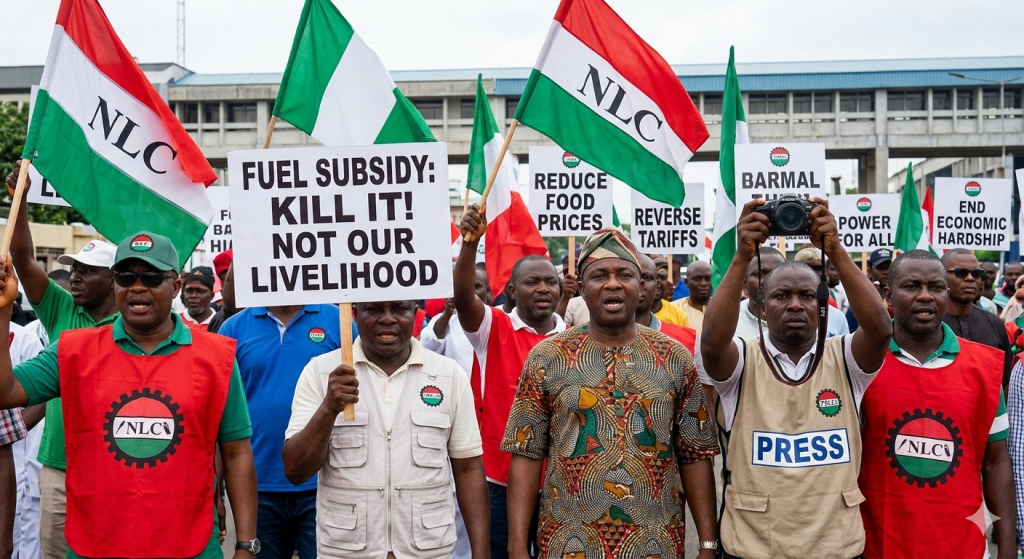
The Nigeria Labour Congress (NLC) has dismissed suggestions that a new national minimum wage of N100,000 would adequately address the economic challenges facing Nigerian workers, insisting that salaries must better reflect the country’s current cost-of-living realities.
Speaking in reaction to reports that state governors are considering a minimum wage review to N100,000, NLC spokesperson Benson Upah argued that the proposed figure falls significantly short of what workers need to survive under prevailing economic conditions.
The proposal was recently referenced by the Chairman of the Nigeria Governors’ Forum and Governor of Kwara State, AbdulRahman AbdulRazaq, who said discussions were ongoing among state governments, the Federal Government, and organised labour on a possible wage adjustment in response to rising inflation and living costs.
However, Upah maintained that while the willingness to review workers’ salaries is welcome, the suggested amount does not adequately address the severe economic pressures confronting workers across the country.
According to him, the continued depreciation of the naira, rising inflation, increased electricity tariffs, higher fuel prices, transportation costs, and the impact of recent tax measures have drastically reduced the purchasing power of workers.
The labour leader argued that when these economic realities are taken into consideration, a significantly higher wage benchmark is required. He suggested that a monthly wage of up to N1 million would be more reflective of current living costs if existing economic conditions persist.
Upah further contended that improved government revenues should make better remuneration for workers achievable. He pointed to increased allocations from the Federation Account Allocation Committee (FAAC) and additional earnings linked to developments in the international oil market as factors that could strengthen government finances.
He emphasized that workers remain the backbone of national productivity and economic growth, stressing that investment in the workforce should be treated as a priority rather than a burden.
The debate over wages has intensified in recent months as many Nigerians continue to grapple with the effects of fuel subsidy removal, currency depreciation, and rising inflation. Although the Federal Government approved a new national minimum wage of N70,000 in 2024 after extensive negotiations with labour unions, organised labour maintains that the value of the wage has already been significantly eroded by escalating living costs.
With food prices, transportation expenses, electricity tariffs, and other household costs continuing to rise, labour unions have renewed calls for another wage review that reflects the realities faced by workers and their families.
As discussions continue, the Nigeria Governors’ Forum has yet to formally present a new minimum wage proposal to the Federal Government and organised labour for negotiation.
Source: Adapted from a report published by The Punch. Rewritten for PlightTalk.