






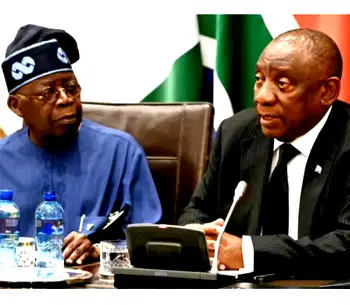
President Bola Ahmed Tinubu reportedly declined to receive a special envoy sent by South African President Cyril Ramaphosa as diplomatic tensions escalated over renewed xenophobic attacks against Nigerians and other African nationals living in South Africa. The decision followed growing outrage over recent attacks, including the reported death of a Nigerian citizen in Cape Town.
According to reports, the South African delegation, led by the country’s Minister of International Relations and Cooperation, Ronald Lamola, arrived in Abuja to deliver a message from President Ramaphosa. However, President Tinubu directed that the delegation be received instead by the Minister of State for Foreign Affairs, Ambassador Sola Enikanolaiye, while the substantive Minister of Foreign Affairs, Bianca Odumegwu-Ojukwu, was on official duty outside the country.
During the meeting, the Nigerian government strongly condemned the recurring xenophobic attacks and called on Pretoria to take concrete measures to protect Nigerians and other African migrants. Nigerian officials also urged South Africa to ratify the bilateral Early Warning Mechanism agreement, arguing that its implementation would improve cooperation in preventing attacks and responding to threats against citizens of both countries.
In response, Ronald Lamola reiterated South Africa’s opposition to xenophobia, racism and all forms of discrimination. He said President Ramaphosa remained committed to strengthening bilateral relations with Nigeria while maintaining South Africa’s right to enforce its immigration laws in accordance with its constitution.
The diplomatic row comes after repeated incidents of violence targeting foreign African nationals in South Africa, prompting Nigeria to intensify calls for stronger continental action through the African Union and other regional bodies. Nigerian officials have maintained that while every sovereign state has the right to enforce its immigration laws, such enforcement must respect human rights and the rule of law, and must never become a justification for violence or extrajudicial attacks against migrants.
The latest developments underscore the strain on relations between Africa’s two largest economies and renew concerns over the safety of African migrants within the continent. Many observers argue that addressing xenophobia will require not only stronger law enforcement but also sustained public education, political leadership and regional cooperation to promote African solidarity and protect the rights of all citizens.